
Why Do We Hold Stretches So Long in Yin Yoga?
- Rebecca

- Aug 11
- 4 min read

If you’ve ever taken a traditional yoga or fitness class, you’re probably used to moving through stretches fairly quickly.
You enter the stretch, hold it for a few breaths, and move on.
In yin yoga, we do something very different.
We settle into a comfortable stretch and stay there—often for several minutes.
If you’re new to yin, that can sound intimidating. You might imagine several minutes of gritting your teeth while trying to sink deeper and deeper into an intense stretch.
But that’s not the goal at all.
In fact, one of the most important principles of yin is almost the opposite:
The goal is time, not force.
What Happens When You Stay in a Stretch?
When you first enter a stretch, the most obvious thing you may notice is the sensation of tightness.
Maybe you immediately feel your hamstrings. Or your hips. Or an area of your back that has been feeling stiff all week.
If you move on quickly, that initial sensation may be most of what you experience.
But when you stay for a while—without pushing—you have time to stop doing the stretch and simply experience it.
Your breathing may begin to settle.
You might notice that you're clenching your jaw or gripping somewhere completely unrelated to the area you're stretching.
You may realize that you're unconsciously fighting the position.
Or you might notice that, after a minute or two, the position simply feels different than it did when you started.
Longer holds give you time to notice those changes.
Longer Doesn't Mean Deeper
This distinction is important.
Holding a stretch longer does not mean trying to tolerate an increasingly intense sensation.
If you enter a yin pose at your absolute maximum, staying there for several minutes probably isn't going to feel particularly calming—or helpful.
Instead, I encourage people to find a version of the position they can comfortably stay with.
That might mean backing out of the stretch.
It might mean bending your knees.
It might mean placing a block underneath you or using a bolster to support part of your body.
There's no prize for getting closer to the floor.
And there's no "perfect" version of the pose you're supposed to achieve.
You want enough sensation to know that you're stretching, but enough ease that you can remain there without constantly fighting your body.
Why We Use So Many Props
If you've seen photos of yin or restorative yoga, you may have noticed a lot of equipment:
Bolsters. Blocks. Blankets. Straps.
They're not there to make the practice more advanced.
They're there to make it more accessible.
A block can bring the floor closer to you.
A bolster can take some of your body weight.
A blanket can cushion a sensitive knee or make a position more comfortable.
Rather than asking your body to conform to a particular pose, we can adjust the pose to work with the body you brought to class that day.
And that body may be different from the one you had yesterday.
There's a Mental Side to Longer Holds, Too
Staying still can be surprisingly revealing.
When you're accustomed to moving quickly—from one exercise to another, one task to another, one notification to another—several quiet minutes can feel like a long time.
You may find yourself thinking:
How much longer are we staying here?
Should I be doing something?
Can I go deeper?
That's part of the practice, too.
Rather than automatically responding to every sensation or thought, you have an opportunity to notice what's happening.
Can you soften somewhere?
Can you breathe without trying to change anything?
Can you let the prop support you instead of holding yourself up?
For people who spend much of their day doing, fixing, accomplishing, and rushing, that can be a very different experience.

What About the Nervous System?
Slow, comfortable movement can also create an opportunity for the body to shift away from constant effort.
But it's worth making an important distinction: a long-held stretch doesn't automatically calm the nervous system.
If you're forcing yourself into an uncomfortable position and waiting desperately for it to end, your experience may be anything but relaxing.
That's another reason intensity matters.
The combination of comfortable positioning, support, unhurried breathing, stillness, and time can create conditions that make settling easier.
We're not forcing the body to relax.
We're giving it an opportunity to.
Why I Pair Yin With Restorative Yoga
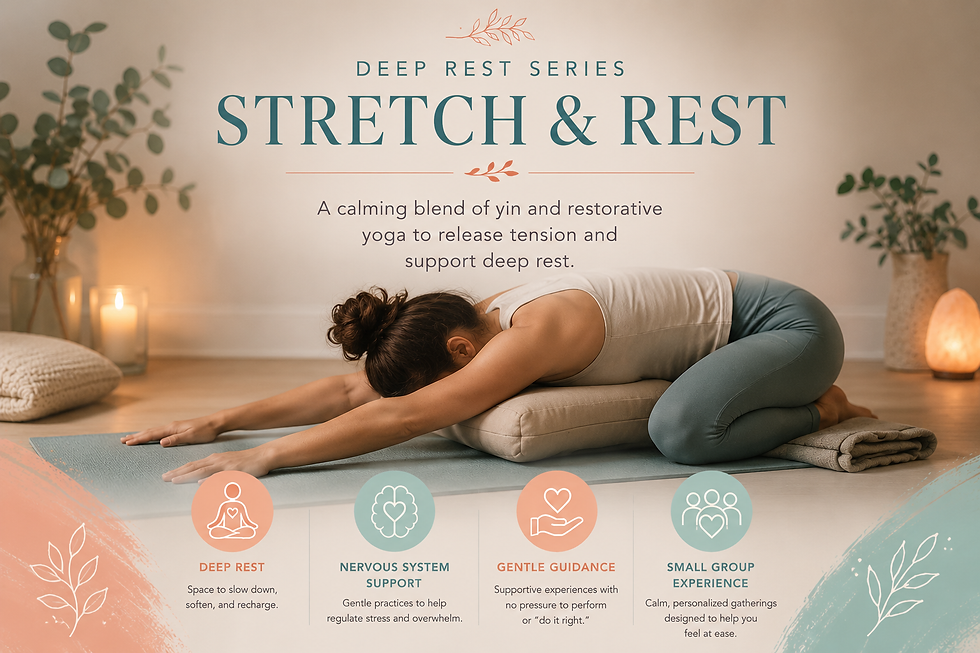
This is one of the reasons I combine the two practices in Stretch & Rest.
Yin gives us time to explore gentle, longer-held stretches and bring attention to areas that feel tight.
But eventually, we stop stretching.
That's where restorative yoga comes in.
Using bolsters, blankets, and blocks, we support the body in comfortable positions where there is very little to do.
No deeper stretch to achieve.
No pose to perfect.
No destination we're trying to reach.
I think of the progression simply:
First, we make space. Then, we rest.
You Don't Have to Be Flexible to Practice Yin
In fact, flexibility isn't the point.
You don't need to touch your toes.
You don't need previous yoga experience.
And you certainly don't need to be able to make your body look like someone else's version of a pose.
A useful yin practice meets you where you are.
Some days that may mean finding a little more space.
Other days it may mean using three props and barely stretching at all.
Both count.
Because the goal isn't to prove how far your body can go.
It's to give yourself enough time to actually listen to it.
Experience Yin + Restorative Yoga at Stretch & Rest
If you've been feeling physically tight—or you've simply been craving an evening where no one expects you to rush—Stretch & Rest: A Gentle Yin & Restorative Yoga Experience combines longer-held, supported stretches with deeply restful restorative poses.
No yoga experience is necessary, and all props are provided.



Comments